Keeping industrial chillers reliable is not about firefighting. It is about control.
Unplanned chiller breakdowns lead to lost production, wasted energy and expensive reactive call-outs. A structured planned preventative maintenance (PPM) programme reduces those risks by catching problems early, stabilising performance and keeping compliance under control.
This practical 12-month industrial chiller PPM checklist is written for UK sites running process cooling or comfort cooling systems. It reflects real-world operating conditions, seasonal risk, and F-Gas obligations, while staying flexible enough to adapt to different duty profiles, environments and refrigerant charges.
Use this as a working template. Apply the frequencies that match your site, document the results, and you will see fewer faults, steadier energy performance and predictable maintenance costs.
A Printable 12 Month Checklist
📄 Download the 12-month industrial chiller PPM checklist (PDF)
First, quick definitions you can share with your team
- What is a PPM programme? A planned, scheduled set of inspections, tests and servicing actions designed to prevent failures, extend asset life and maintain compliance through planned preventative maintenance. It is documented, risk based and tracked against KPIs. For context, see our overview of preventative maintenance within a chiller unit maintenance plan.
- What is preventative maintenance? Proactive tasks that reduce the likelihood and impact of breakdowns, ranging from coil cleaning and leak checks to oil analysis and alarm testing.
- How often should chillers be serviced, and how frequent should maintenance be done? For most industrial sites in the UK, plan quarterly engineer visits plus light monthly operator checks, with targeted pre-summer and pre winter commissioning. High criticality or harsh environments often justify bi monthly visits. F‑Gas leak testing frequency is set by refrigerant charge and system type, so adjust accordingly.
- Should chillers be cleaned? Yes. Clean condenser coils, strainers and air paths are essential to prevent high pressure trips and restore seasonal energy performance. Dirty coils can add double digit percentageincreases to kWh per kW of cooling.
The maintenance golden rule and the 10 percent rule
- Maintenance golden rule: do the simple tasks on time. Filters, coils, strainers, setpoints and alarms. These low cost actions prevent the big failures, protect compressors and keep efficiency steady.
- The 10 percent rule of preventive maintenance: a small, planned spend on maintenance, typically around 10 percent of the annual operating cost of a chiller system, avoids far higher reactive costs. As a budgeting anchor, it is a guide, not legislation. If plant is aged, critical, or in a dusty or corrosive location, raise the allocation and combine it with targeted upgrades like variable speed drive HVAC controls to capture energy savings.
Without a structured plan, sites are forced into emergency breakdown support, higher costs and avoidable downtime.
Daily operator checklist for chiller systems
Assign a responsible person to record readings. Five minutes a day reduces hours of downtime later.
- Log leaving and return fluid temperature, suction and discharge pressure, and ambient.
- Check for alarms or trips, confirm all safety interlocks are healthy.
- Walk the air path, remove debris around air cooled chillers, confirm fans and pumps run smoothly.
- Look for obvious leaks, oil stains, unusual vibration or noise.
- Verify the BMS or local controller is tracking the correct setpoints and that deadbands are sensible for the season.
- Confirm strainers have no visible differential pressure indication where fitted and that pump inlets are not starved
Why this matters: Five minutes of daily checks prevents hours of unplanned downtime and flags developing faults before they trip the system.
Monthly routine tasks
- Visual refrigerant leak check to F‑Gas standards with traceable logbook entries; escalate to instrumented testing if signs are present.
- Inspect condenser and evaporator coils, clean light fouling, straighten fins, clear intakes and discharge paths.
- Check glycol or water level in the buffer tank or header, confirm expansion vessel charge where accessible.
- Test basic alarms, including flow proof, high pressure, low pressure, and frost protection status.
- Inspect lagging and insulation on outdoor pipework; repair any damage that risks condensation or frost ingress.
- Review controller trends for short cycling, excessive starts per hour, or long compressors at marginal superheat.
Why this matters: Monthly visual and functional checks catch airflow, flow and control issues that quietly drive energy waste and nuisance alarms.
Want this applied to your site?
A checklist is only effective if it matches your duty profile, environment and refrigerant charge. We carry out baseline PPM audits to align maintenance frequency, F-Gas testing and seasonal commissioning to how your chiller actually runs.
Request a PPM baseline review or call 0121 820 8946.
Quarterly engineer visits
- F‑Gas leak testing with calibrated electronic or ultrasonic instruments as required by charge and system category, plus record keeping.
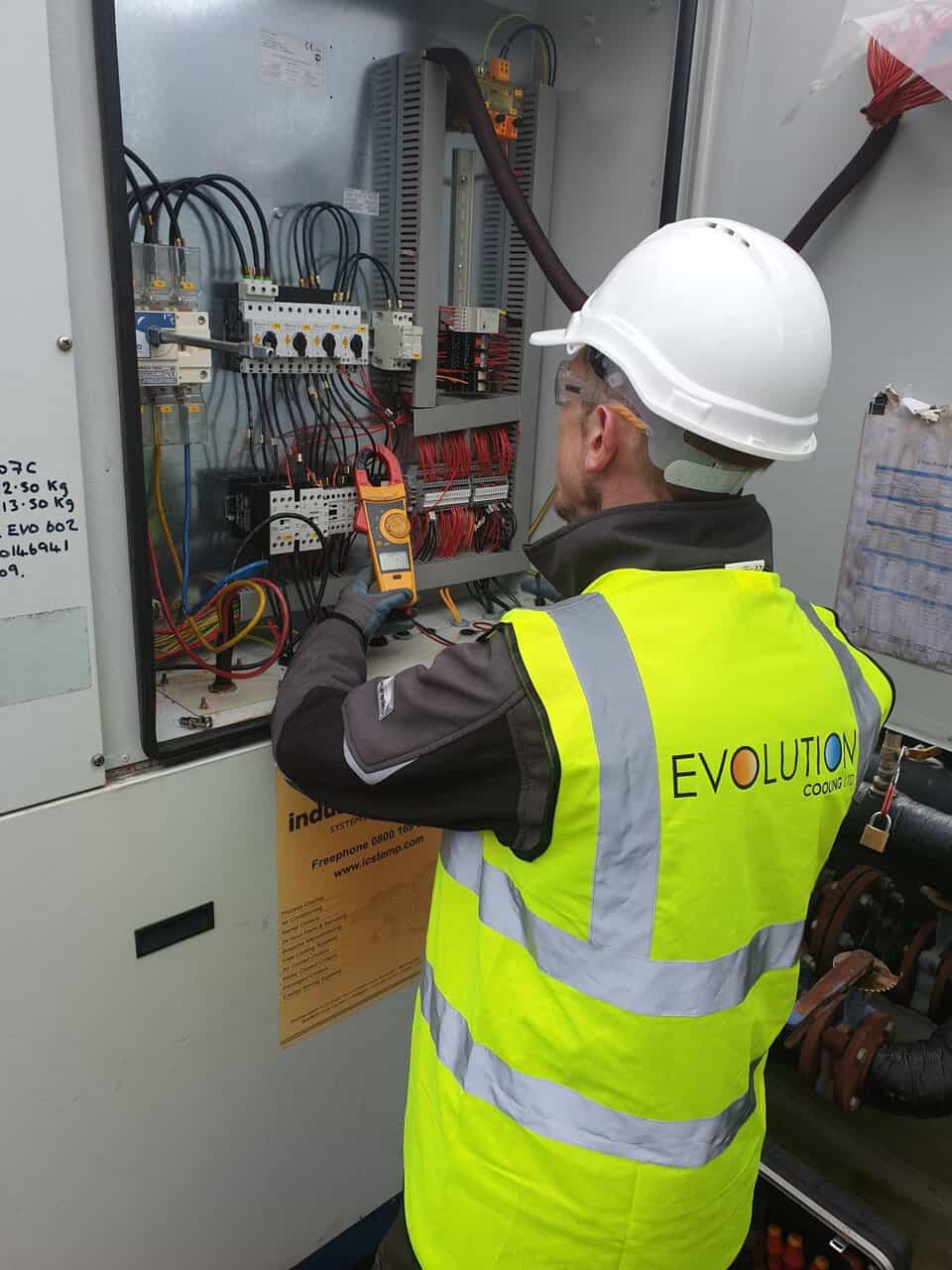
- Full electrical and control check, contactor condition, fan speed controller health, sensor calibration spot checks, PLC input sanity verification.
- Hydraulic checks, pump performance verification, strainer removal and clean, plate heat exchanger pressure drop comparison against baseline.
- Oil level and condition screening, refrigerant sight glass observation where present, superheat and subcooling measurement to confirm charge health.
- Condenser deep clean where fouling exceeds light dust, including detergent foam for greasy sites, followed by rinse and airflow verification.
- Control optimisation, review ambient compensated setpoints, confirm smooth free cooling or adiabatic assist changeover if fitted.
Why this matters: Quarterly inspections are where early mechanical, electrical and refrigerant issues are identified before they become compressor failures or F-Gas incidents.
Seasonal commissioning, pre summer and pre winter
- Pre summer, clean condenser coils thoroughly, validate fan operation and airflow, test high pressure cut-outs, confirm condenser approach temperatures and ensure the intake zone is clear of new obstructions.
- Pre winter, verify glycol concentration and freeze margin, dosage of inhibitors and pH for corrosion control, test low ambient fan controls, crankcase heaters and frost alarms, and confirm lagging integrity on exposed pipework.
- For systems using free cooling, rehearse automatic changeover at safe loads, confirm modulating valves track leaving fluid temperature and that the BMS sequence avoids bang bang cycling.
For critical processes, contingency planning should also include temporary chiller hire to protect production during peak summer demand or major maintenance.
Why this matters: Most chiller failures happen at seasonal extremes. Commissioning ahead of summer and winter removes predictable risk before demand peaks.
Annual tasks and deeper inspections
- Oil and refrigerant analysis for critical compressors, looking for acid content, moisture and wear metals; act on trends before failure.
- Calibration of all critical temperature and pressure sensors against a known reference; update scaling in controllers as required.
- Drain and flush evaporator water circuits where water quality is poor, then dose and document inhibitor levels. For glycol systems, follow your glycol health programme rather than
- arbitrary replacement; onlyreplace when condition dictates.
- Relief valve test or replacement per manufacturer guidance and local policy; verify trip values.
- Review spare parts strategy, hold belts, fan controllers, contactors, compressor service kits, sensors and gasket sets sized to your installed base. Validate lead times for non stocked chiller parts and identify single points of failure.
Why this matters: Annual deep inspections establish condition trends, not just pass/fail checks, allowing planned intervention instead of reactive replacement.
Leak detection routines and F‑Gas compliance
- Align testing frequency to CO2‑equivalent threshold and leak detection system presence. Where fixed detection is installed, verify sensor function and calibration annually.
- Keep a complete logbook, including charge quantity by circuit, tests performed, instruments used, and any remedial works. A structured programme reduces refrigerant loss, improves efficiency and keeps you audit ready.
Why this matters: Structured leak detection reduces refrigerant loss, improves efficiency and keeps you audit-ready without disruption.
Water and glycol quality management
- Test concentration, freeze point, inhibitor level and pH at least biannually, more often for outdoor or free cooling heavy systems.
- Do not mix chemistries. Top up with the correct inhibited product, and size pumps for winter viscosity to avoid low flow alarms when temperatures drop.
- For a dedicated glycol chiller or mixed circuit, confirm plate heat exchanger materials match the chemistry to avoid accelerated corrosion.
KPIs to track and report
- Mean Time Between Failures, target steady improvement across seasons by removing repeat faults.
- Energy intensity, kWh per kW of delivered cooling or kWh per tonne of product. Track pre and post coil cleans, setpoint changes, and fan control adjustments.
- Starts per hour, compressor and pump cycling should sit within manufacturer limits.
- Leak rate, kg of refrigerant added per year as a percentage of charge, with a target trending down to zero.
- Planned vs reactive hours, keep reactive work under 20 percent of total maintenance time.
Why this matters: KPIs turn maintenance from a cost into a measurable performance improvement tool.
Budgeting tips for the financial year
- Anchor your maintenance budget around the 10 percent rule, then adjust for asset age, environment and criticality. Allocate a ring fenced pot for coil cleaning and water treatment, they deliver reliable savings.
- Build a spares buffer for long lead items and seasonally sensitive components. Holding the right fan controller or pressure sensor often prevents multi hour stoppages.
- Combine PPM with targeted upgrades that pay back quickly, such as variable speed drive HVAC fan control, better filtration on air intakes, or refined control sequences that widen dead bands without harming process stability.
How often should chillers be serviced, in practice
- Light duty comfort cooling in clean environments, two to four planned visits per year with pre season commissioning is typical.
- Process critical sites with harsh conditions or 24/7 operation, monthly to bi monthly engineer attendance is justified, supported by daily operator checks and quarterly deeper tasks.
A printable 12 month snapshot
📄 Download the 12-month industrial chiller PPM checklist (PDF)
Want this sent to you by email?
Get the checklist plus seasonal maintenance reminders.
- Daily, operator log and visual checks.
- Monthly, visual leak check, coils and air path, alarms, insulation, header levels.
- Quarterly, instrumented leak tests, electrical and control checks, strainers and hydraulics, charge health, deep coil clean.
- Pre summer, airflow and HP protection, full condenser clean, fan and controller validation.
- Pre winter, glycol health, frost protection and low ambient controls, insulation repairs.
- Annual, oil and refrigerant analysis, full calibration, relief valves, water treatment flush as needed, spares review and KPI reset.
If you need a more detailed breakdown by system type and duty, see our guide on how often a chiller should be serviced.
Frequently Asked Questions
FAQ 1
Question
How often should industrial chillers be serviced?
Answer
Most industrial chillers benefit from quarterly planned maintenance visits, supported by daily operator checks and seasonal commissioning. Critical or harsh-environment systems may require monthly or bi-monthly attendance.
FAQ 2
Question
What is included in a chiller PPM programme?
Answer
A structured chiller PPM programme typically includes operator checks, refrigerant leak detection, electrical and control inspections, hydraulic checks, coil cleaning, seasonal commissioning, compliance reporting and performance KPI tracking.
FAQ 3
Question
Is chiller maintenance a legal requirement in the UK?
Answer
While general maintenance is not legally mandated, UK sites must comply with F-Gas regulations, including leak detection, record keeping and refrigerant management. Planned maintenance supports compliance and reduces the risk of non-conformance.
FAQ 4
Question
What happens if a chiller is not properly maintained?
Answer
Poor maintenance increases the risk of breakdowns, higher energy consumption, refrigerant loss, compressor failure and unplanned downtime. Over time, this leads to higher operating costs and reduced equipment lifespan.
Why Partner With Evolution Cooling?
At Evolution Cooling, we implement structured PPM programmes that combine scheduled servicing, seasonal commissioning and 24/7 emergency cover, supported by certified F‑Gas engineers and documented compliance. We can integrate commercial hvac services such as upgrades, hire cover during major works, and optimised control strategies that cut energy while protecting uptime. For design tweaks or future capacity planning that reduce run hours and improve stability, our team can also advise on cooling system optimisation.
Book your PPM kick off and spares audit
Secure Q1 now and remove guesswork from your chiller maintenance. We will survey your system, set KPI baselines, align F-Gas testing to your refrigerant charge, and build a spares strategy that eliminates single points of failure.
Contact Evolution Cooling on 0121 820 8946 or email [email protected] to schedule your planned preventative maintenance programme and keep your plant stable all year.
📞 0121 820 8946
📧 [email protected]
🌐 www.evolution-cooling.com