
Industrial process cooling: how to specify for uptime, energy efficiency and future expansion
Uptime-critical manufacturing lives or dies by temperature control.
If your cooling drifts, parts warp, batches spoil, welds fail quality checks and alarms cascade. The specification you lock in before tender is the single biggest lever you have to prevent that scenario.
This guide defines industrial process cooling in UK contexts and gives you a practical, pre-tender framework to size, select and structure your plant for dependable performance in the West Midlands climate. It folds in controls, hydraulics, redundancy and future growth, so you avoid overspend, under-specification and nuisance alarms.
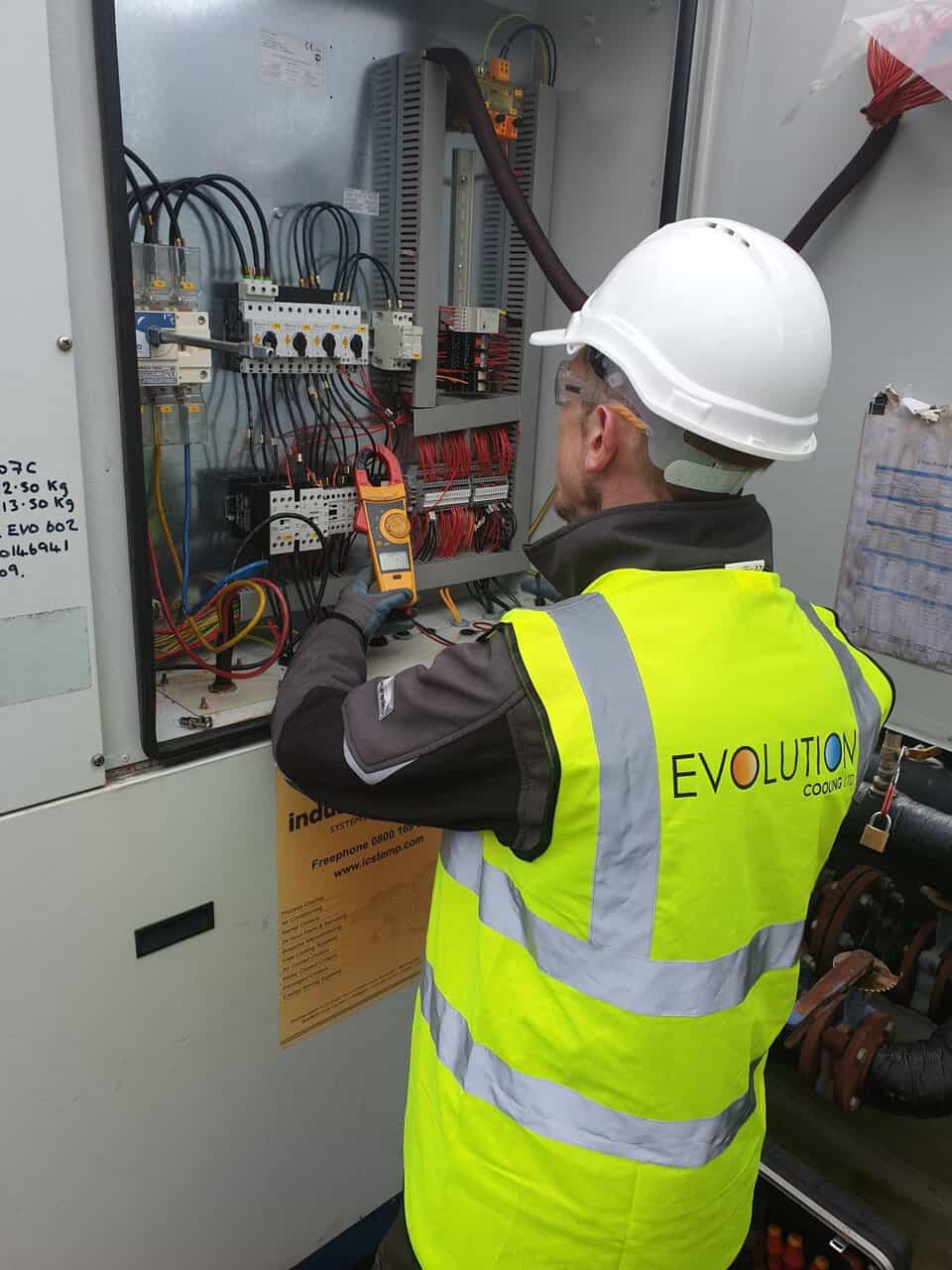
Evolution Cooling supports facilities and OEMs with on-site surveys, PLC validation, installation and commissioning, planned preventative maintenance and 24/7 emergency integration. If you operate in the West Midlands, book a site survey to de-risk your next project.
What industrial process cooling is and where it applies
Industrial process cooling removes heat from production equipment and process fluids to maintain a defined temperature window that protects product quality and equipment life. Unlike comfort cooling, the target is process stability under dynamic loads, frequent starts and stops, and tight tolerances.
Typical UK applications include:
- Automotive welding cells and CNC machines that shed continuous heat and demand steady coolant temperatures for dimensional accuracy.
- Plastics and injection moulding where mould temperature governs cycle time, finish and warpage risk.
- Pharmaceuticals and laboratories requiring validated setpoints, documented alarms and F-Gas compliant maintenance.
- Food and beverage where HACCP requirements make temperature drift a product quality and compliance issue.
- Data and electronics rooms coordinated with CRAC and close-control units for mixed environments.
In these settings, a process chiller, free cooler or adiabatic-assisted system works with stainless pipework, pumps, buffer tanks and controls to hold a stable leaving-fluid temperature across seasons.
A structured approach to sizing and selection
The fastest way to lose money is to size by nameplate estimates. The second fastest is to copy a previous selection without checking climate and diversity. Use this framework before tender:
- Confirm the true heat load and diversity
Profile real duty in kW across shifts. Capture peak, steady and part-load, along with coincidence factors when multiple machines rarely peak together. Validate flow and delta T at each user. Our on-site survey instruments log temperatures and flow to pin down a defensible total load and diversity. - Set ambient design points for the West Midlands
Use local extremes, not generic values. For air-cooled plant in the West Midlands, summer dry-bulb design conditions typically sit around 30 °C with occasional spikes; winter design lows for frost protection often reach -5 to -8 °C in exposed locations. Select condensers and free cooling coils for these edges, and verify head-pressure control and low-ambient strategies. - Define glycol requirements for outdoor circuits
If any pipework or coils are outdoors or you plan to leverage free cooling, specify propylene glycol with inhibitor. Typical concentrations are 25 to 35 percent for outdoor and free-cooling-heavy operation. Confirm pump sizing for winter viscosity and plate heat exchanger selection to maintain approach temperatures. Document the freeze protection margin relative to your coldest leaving-fluid setpoint. - Choose duty, standby and an expansion strategy
Decide whether N+1 is required at chiller or pump level. Multi-chiller arrays with duty/assist/standby reduce single-point risk and enable maintenance without shutdown. Provide valved connections and electrical capacity for future modules. Consider temporary connections for hire plant to cover outages or step-in capacity during ramp-up. - Get the hydraulic design right
Specify stainless-steel headers and pipework for clean circuits and demineralised water where needed. Use plate heat exchangers to isolate sensitive machine fluids from the glycol loop. Size pumps for design duty plus glycol correction, include variable-speed drives (VSDs) for turndown, and provide a correctly sized buffer tank to smooth short cycling and decouple flow. Include air elimination, strainers with easy access and differential pressure gauges for service. - Engineer controls for stability and efficiency
Implement ambient-compensated setpoints so the leaving-fluid target resets when ambient is low, offloading compressors. Use modulating valves with leaving-fluid feedback at critical users. Apply VSDs to fans and pumps for part-load efficiency. Validate programmable logic controller (PLC) inputs, interlocks and alarm thresholds. Widen deadbands where process allows to reduce compressor starts without compromising quality. - Validate and commission to the specification
Pre-commission with instrumented checks: design flow, pump curve validation, glycol concentration, sensor calibration, alarm and safety trip testing, and free cooling or adiabatic changeover logic. Document all setpoints.
For an overview of chiller fundamentals that pair with this framework, see our introduction to the chiller system. To discuss specification and delivery in one package, explore our installation and commissioning capability led by certified F-Gas engineers.
Common pitfalls that trigger downtime and quality drift
- Load inflation or guesswork that leads to oversizing, short cycling and unstable control at part-load.
- Ignoring diversity and ending up with unnecessary capacity that never loads efficiently.
- No glycol on outdoor sections, causing slush formation, low-flow alarms and split coils in winter.
- Undersized or fixed-speed pumps that cannot overcome glycol viscosity at low temperatures.
- Missing buffer volume, so compressors hunt and alarms cascade during rapid load changes.
- Controls not validated during commissioning, with incorrect sensor scaling, tight deadbands and untested free cooling changeover.
- Dirty condensers before summer, resulting in high head pressure and nuisance trips under heat.
Evolution Cooling’s planned preventative maintenance and seasonal alignment eliminate many of these issues. Our teams combine leak testing, coil cleaning, pump and strainer checks, setpoint optimisation and PLC validation to maintain stability through seasonal swings.
When to integrate free cooling or adiabatic assist
Free cooling is attractive when ambient air can reject heat at or below your return-fluid temperature for a meaningful portion of the year. In the West Midlands, many process setpoints and glycol circuits benefit from free cooling during shoulder months and winter, reducing compressor run-hours significantly. Consider integration when:
- Your leaving-fluid setpoint is above roughly 8 to 10 °C, or you can tolerate a seasonal reset.
- You have outdoor space for a dry cooler or integrated free-cooling coil and the pipe runs are practical.
- Controls can manage staged changeover, frost protection and pump turndown without shocks to the process.
Adiabatic assist becomes relevant when summer peaks or tight approach temperatures would otherwise push head pressure high. It can cap peak energy and protect capacity during heatwaves with controlled water use, provided hygiene and water quality are managed.
We routinely engineer PLC logic so free cooling picks up as ambient falls, with glycol protection verified and valves modulating to keep the leaving-fluid steady. Explore how a free cooling chiller can be applied in mixed-duty plants, and see an adiabatic cooler use case for chemical production in our portfolio.
A concise pre-tender checklist
- Confirm logged heat loads, coincidence factors and delta T per machine.
- Fix West Midlands ambient design highs and lows, including microclimate notes.
- Specify propylene glycol concentration, inhibitor type and freeze margin.
- Select duty/standby philosophy and leave valved and powered allowances for expansion and hire plant.
- Finalise hydraulics: stainless pipework, plate heat exchangers, VSD pumps, buffer tank sizing, strainers and air elimination.
- Define controls: ambient-compensated resets, modulating valves, VSDs, alarm limits, PLC inputs and interlocks.
- Plan commissioning: flow verification, sensor calibration, glycol and viscosity checks, alarm trip tests, free cooling and adiabatic changeover testing.
- Align maintenance: coil cleaning, filtration strategy, F-Gas logbook and leak checks, seasonal visits.
If you need a partner across specification, delivery and lifecycle care, our commercial HVAC services cover design, installation, optimisation and response under one roof.
Pre-summer commissioning alignment checklist
- Clean condenser coils and check fan controllers for stable head-pressure control.
- Inspect and replace filters, confirm clear airflow paths and safe intake and discharge separation.
- Validate setpoints and deadbands against product quality limits, not just default controller values.
- Calibrate key sensors, confirm PLC inputs and test alarm logic at realistic thresholds.
- Verify pump performance, strainers, buffer level and glycol concentration for expected summer setpoints.
To lock this in ahead of heat season, coordinate with our commissioning services team; we can also integrate a temporary chiller hire if you need cover during works.
Why partner with Evolution Cooling
We are a West Midlands specialist in uptime-critical environments. Our on-site surveys establish true loads and diversity. Our engineers design glycol-protected hydraulics with stainless pipework, plate heat exchangers, VSD pumps and correctly sized buffer tanks. We validate PLC logic, ambient-compensated resets and alarm thresholds, then provide planned preventative maintenance with documented F-Gas compliance and 24/7 emergency integration. When needed, we deploy hire plant and recommission to verified setpoints to protect production.
Summary and next step
A resilient process cooling specification starts with measurement, respects local climate and bakes in glycol protection, redundancy, hydraulics and controls that match the way your plant actually runs. Do this before tender and you reduce risk, lower energy use and eliminate nuisance alarms. If you operate in the West Midlands, book a site survey with Evolution Cooling to align specification, installation and maintenance around uptime, energy efficiency and future expansion.
FAQ
What is industrial process cooling used for?
It stabilises process temperatures in manufacturing, such as automotive welding, plastics, pharma, food and beverage, and laboratories, preventing defects and protecting equipment.
How do you size and specify correctly?
Measure real loads and diversity, set local ambient extremes, specify glycol for outdoor circuits, select duty/standby, design hydraulics with stainless pipework, plate heat exchangers, VSD pumps and buffer volume, and validate controls with ambient-compensated setpoints and PLC testing.
What pitfalls cause downtime and quality drift?
Oversizing, missing glycol, undersized pumps, no buffer, dirty condensers and unvalidated controls are the most common.
When should free cooling or adiabatic assist be used?
Free cooling suits setpoints that allow ambient offload during cooler months. Adiabatic assist helps maintain capacity and efficiency during hot spells or when tight approach temperatures are required.
Emergency Breakdown Support
Planned Preventative Maintenance
Industrial Chiller Sales
Industrial Chiller Hire
Get in Touch with an Experienced Chiller Technician Today
We will:
-
Review your system configuration
-
Assess historical fault patterns
-
Identify risk exposure
-
Recommend an appropriate service level
-
Provide transparent pricing
Speak to an engineer today to discuss your maintenance requirements.